
Selling an inherited house in Ireland can start before probate finishes, but the sale cannot close until the executor holds the grant of probate. A second figure also shapes the sale: what the house was worth on the day the person died. Revenue measures any gain against it.
Budget 2027 changed the capital gains tax (CGT) rate and the inheritance tax thresholds on 7 October 2026, so any guide written before then quotes the old figures.

Who can sell an inherited house in Ireland?
When someone dies owning a house, authority to sell it sits with the personal representative: the executor named in the will, or an administrator the court appoints where there is no will. The Probate Office issues a grant of probate to an executor, or letters of administration to an administrator. That grant confirms authority over everything the deceased left, house included. An executor who wants to sell an inherited property needs the grant to complete the sale.
Not every house needs a grant. Where the deceased owned the property as a joint tenant, ownership usually passes to the surviving owner, and a solicitor confirms that from the title.
Beneficiaries who inherit a property can also keep it as the family home or let it as an investment, because no rule obliges a beneficiary to sell. A let property brings income tax and tenancy rules of its own. Where the will leaves the house to a named person, the executor can transfer it by assent. Transferring property this way needs the grant before the Land Registry, now part of Tailte Éireann, registers the change under its assent rule. Once the house is in a beneficiary’s name, that beneficiary is the owner and signs the contract as seller. Where the beneficiaries decide to sell during the administration, the executor signs and the proceeds pass through the estate. The estate’s solicitor confirms which position applies.
Listing doesn’t wait for the grant.

Can you sell an inherited house in probate?
Yes to marketing and agreeing a sale. No to closing it. The executor can instruct an estate agent, hold viewings and accept an offer while the probate process runs, so a probate house sale can go sale agreed before the grant issues.
The executor cannot sell the property outright until the grant arrives, because completion needs it to transfer ownership to the buyer. Contracts commonly carry a long-stop date linked to the grant, and the executor’s solicitor decides when contracts exchange.
Older guides say an agreed sale can speed up the grant. The Courts Service states that the Dublin Probate Office does not expedite applications to facilitate the sale of a property. Its published processing times, updated on 12 October 2026, show the Dublin office working through solicitor applications lodged on 13 July 2026. Applications through the online Probate Portal, which solicitors use for grants of probate, were running at around three to four weeks. They show the position on that date and do not guarantee turnaround times.
When selling a house in probate, a buyer relying on a mortgage holds an approval with an expiry date, so the closing date has to be a realistic estimate from the first offer. A vague timetable hands that buyer a reason to leave.
How do you value an inherited house for sale?
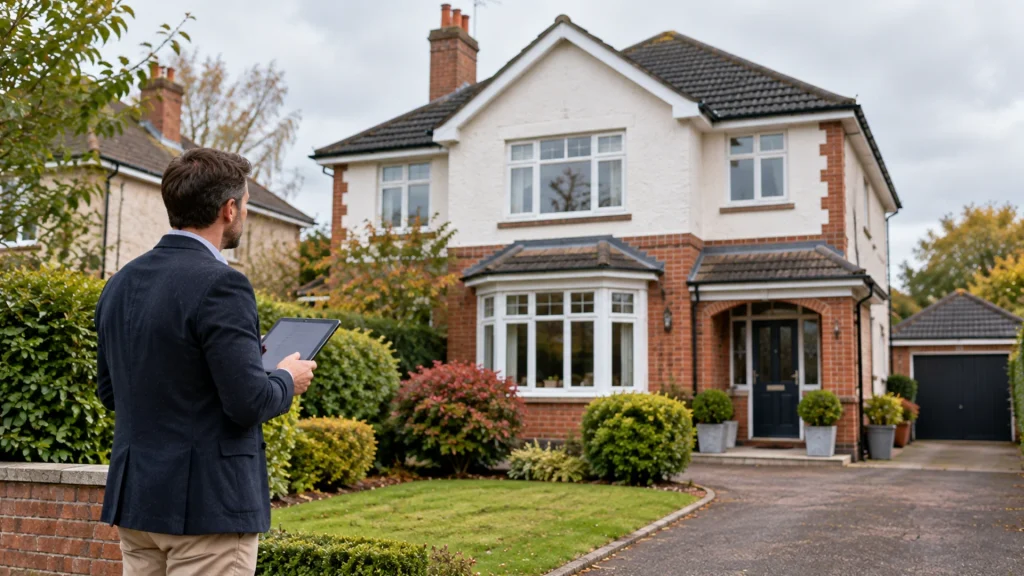
An estate agent or valuer values the house twice, because two valuations do two different jobs. The first is the date of death valuation: the market value of the house on the day the owner died. The executor lists it in the application for probate purposes, and Revenue uses it as the base for any later gain. CAT uses a separate valuation date. Revenue sets it at the earliest of three dates: when the executor becomes entitled to retain the house for the beneficiary, when the executor retains it and when the executor gives it to the beneficiary. That date can fall after death, so the two valuations can differ. DNG Farrelly Southern’s guide to probate valuation explains how a formal report differs from a standard market appraisal.
The second is today’s market value, which sets the asking price. A house worth €450,000 on the date of death can be worth more or less by the time it lists, and that gap drives both the tax and the arguments. An estate agent can provide both figures. A market appraisal ahead of a sale is often free, while a formal written valuation for probate is a separate document and the fee varies by firm.
Beneficiaries who want to avoid an argument about property value later agree on one valuer, in writing, at the start.

How much tax do you pay on an inherited house in Ireland?
Capital Acquisitions Tax (CAT), which arises on the inheritance itself and which most people call inheritance tax, charges 33% on whatever a beneficiary receives above their lifetime tax-free threshold. The relationship to the deceased sets the bracket.
| Group | Beneficiary’s relationship to the deceased | Threshold for inheritances taken on or after 7 October 2026 | Previous threshold |
| A | Child of the deceased, minor grandchild whose parent has died, or a parent inheriting absolutely from a child | €420,000 | €400,000 |
| B | Brother, sister, niece, nephew, grandparent or grandchild | €44,000 | €40,000 |
| C | Anyone else | €22,000 | €20,000 |
Inheritances between a spouse or civil partner and the deceased are exempt. Revenue values the house as part of any inheritance for inheritance tax purposes at the valuation date, which also sets the filing and payment dates. The threshold itself usually follows the date of death, not the valuation date. Revenue’s group definitions carry further exceptions that affect children or grandchildren of the deceased in some family situations, so a solicitor or tax adviser confirms which group and valuation date apply to a particular inheritance.
In an illustration, a child inherits a €500,000 house from a parent, with no earlier Group A gifts or inheritances. That leaves €80,000 above the €420,000 threshold, and 33% of that is €26,400.
The dwelling house exemption removes CAT from an inherited house when every condition holds. The house was the deceased’s only or main home at the date of death. The beneficiary lived in it as their only or main home for the three years before the inheritance, owns no other house and acquires no interest in another house from the same person. The house then stays their only or main home for six years. The six-year condition does not apply to a beneficiary aged 65 or over at the date of the inheritance, and Revenue lists other limited exceptions. Lifetime gifts of a house lost the exemption from 25 December 2016, except gifts to dependent relatives.
The six-year condition connects to selling: a beneficiary under 65 who sells inside that period no longer meets it. A tax adviser confirms the effect on a particular inheritance.

Do you pay capital gains tax on an inherited house?
Nothing falls due on the inheritance itself. A later sale can trigger the charge. Revenue treats an asset passed on after death as acquired at its market value on the date of death, so the charge falls only on growth above that value.
To calculate the gain, Revenue subtracts the date of death valuation and allowable costs from the sale price. Allowable costs include agent and legal fees and enhancement expenditure, meaning work that adds value to the house.
Revenue’s CGT guidance gives the current rate for most gains as 31%. Revenue’s Tax and Duty Manual applies it to disposals made on or after 7 October 2026, down from 33%. Each individual also has an annual personal exemption of €1,270.
Take a house worth €450,000 on the date of death that a beneficiary sells for €480,000, with €9,500 in agent and legal costs. The gain is €20,500. After the €1,270 exemption, €19,230 is taxable, and 31% of that is €5,961. The same sale before 7 October 2026 at 33% produces €6,346.
Who sells changes the position. Revenue treats personal representatives who sell during the administration as a body of persons whose gains are their own, and it includes the expenses of obtaining the grant among their allowable expenditure. A beneficiary who takes the house from the personal representatives acquires it on the same basis, at the date of death value. Revenue states the €1,270 exemption is for individuals and not for companies, trustees or other non-corporate bodies. A tax adviser confirms whether it applies to a sale by an executor.
What if the house sells above or below probate value?
A sale above the date of death valuation creates a gain. A sale below it produces a loss, which Revenue’s rules allow to offset gains, subject to conditions. A sale near that value leaves little gain, so a quick sale after the grant often carries a small tax bill. If prices rise before the sale, the gain grows with them.
Under Revenue’s deadlines, tax on disposals between 1 January and 30 November falls due by 15 December, and tax on December disposals by 31 January of the following year. A return is due by 31 October of the year after the disposal, and Revenue states this applies even where reliefs or allowable losses mean no tax is due. For a disposal under a written contract, Revenue states that the time of disposal is usually the date of the contract. Revenue lists Form 1 as the return for an estate, and Form CG1 or an income tax return for an individual. A solicitor or tax adviser confirms who reports a particular sale, which can depend on whether the executor or the beneficiary sells. DNG Farrelly Southern’s guide to CGT on property sales covers the wider rules.
This guide gives general information on Revenue’s published rules as at October 2026. It does not replace professional advice, and a solicitor or tax adviser confirms how the rules apply to a particular estate.

What if a sibling refuses to sell an inherited house?
A sibling’s refusal does not end the options, which run from mediation and a buyout to a court application.
While the house sits in the estate, Section 50 of the Succession Act 1965 states that no beneficiary has to concur in a sale by the personal representatives. They give effect, so far as practicable, to the wishes of beneficiaries of full age or, where those beneficiaries disagree, of the majority by value. The terms of the will also bear on the position.
Where the house has passed to the beneficiaries by assent, they hold it as co-owners and a sale needs all of them to sign. Section 31 of the Land and Conveyancing Law Reform Act 2009 lets any co-owner apply to the court. The court can order partition or a sale, make accounting adjustments between co-owners, such as an occupation rent from a co-owner who lives in the house, or dismiss the application. A solicitor advises on the executor’s authority and on whether an application suits a particular dispute.
Co-owners who want to sell and co-owners who want to stay need to consider a compromise, and mediation can turn “I won’t sell” into a buyout, or into a rent for the sibling living there. In a buyout, one beneficiary keeps the house and pays the others their share at an agreed market value, possibly funded by a new mortgage.
How long does it take to sell an inherited house?
The grant sets most of the timeframe. Probate Portal applications run at about three to four weeks and Dublin solicitor applications at around three months, before the sale and the tax filings add their own time. An inherited house sells in three stages, and two are additional steps beyond an ordinary home sale: the grant before it and the tax filings after it. Listing while the solicitor prepares to apply for a grant lets the grant and the sale overlap. That overlap saves the most time.
Waiting costs money. The estate incurs insurance and upkeep costs from the date of death until closing. Insurers commonly place conditions on cover once a house stands empty. If the deceased had a mortgage, the lender is repaid from the sale proceeds unless a life insurance or mortgage protection policy has already cleared it.
A spring listing of a house still full of furniture gains little from the season, so the best time to list is when the house is clear and the grant application is moving.

How do you prepare an inherited house for sale?
Start with the contents. Decades of belongings take longer to clear than a grant takes to issue. The contents form part of the estate, so who takes what is a matter for the executor and the estate’s solicitor. Once the house is empty, clean it and fix what a buyer sees first: the damp patch on the ceiling, the gutter hanging off the fascia. Buyers read an empty house with a defect list in their heads, and each visible fault becomes a request for a lower price.
Light repairs and neutral paint do more per euro than a renovation. Receipts for work and professional fees support the allowable costs covered above, and a tax adviser confirms which items count.
Irish law requires a BER certificate before anyone advertises a property for sale. An existing certificate stays valid for ten years, so the first question is whether the house already holds one.
Frequently asked questions
Is there a seven year inheritance tax rule in Ireland?
No. The seven year rule is a UK inheritance tax idea, and CAT has no equivalent. A beneficiary who has to pay any inheritance tax pays it at 33% on the amount above the lifetime threshold.
Is there a seven year capital gains tax rule in Ireland?
Only a limited one. Revenue’s relief covers land or buildings acquired between 7 December 2011 and 31 December 2014, held for at least four years and sold on or after 1 January 2018. Revenue’s guidance describes it as applying to property acquired for full consideration, or for at least 75% of market value from a relative. A tax adviser confirms whether it applies to a particular property.
Is stamp duty payable on an inherited house?
None. Revenue states that stamp duty does not apply to property inherited under a will or on intestacy. A buyer who purchases the house from the estate pays stamp duty on that purchase.
Can a child inherit the Group A threshold from each parent?
No. Group A is one lifetime threshold. Inheritances from both parents count towards the same figure.
Can an executor sell an inherited house without every beneficiary’s agreement?
Often, yes. Section 50 of the Succession Act 1965 states that no beneficiary has to concur in a sale by the personal representatives, who give effect to the beneficiaries’ wishes so far as practicable. A solicitor confirms how the section applies to a particular will.
Is there a two year rule for inherited property in Ireland?
Revenue’s CGT guidance refers to a two year period for a deed of family arrangement. Where a deed varies how a will or intestacy distributes the property within two years of death, or a longer period Revenue allows, the deed takes effect from the date of death and does not count as a CGT disposal. A solicitor or tax adviser confirms whether it applies to a particular estate.
How long can you keep an inherited house?
There is no fixed deadline to sell. Timing runs through the rules covered above: the six-year condition in the dwelling house exemption for a beneficiary who qualifies, and CGT, which measures any gain from the date of death value, so a rising market adds to it. A tax adviser confirms how these apply to a particular inheritance.
Do you need a solicitor to sell an inherited house?
Usually. Irish property sales run through solicitors for conveyancing, and the same solicitor often handles the probate application for the estate.

Need a free valuation for an inherited house in Kildare?
If you are the executor, a free market valuation from DNG Farrelly Southern on an inherited house in Kildare or Meath gives you a written figure to work from. It sits alongside the formal date of death valuation described above. An executor carries two jobs at once: administering an estate and having to sell a property from it, often while grieving a loved one. For many executors that’s a daunting prospect.
From the valuation, we market the house, run viewings on an empty property and handle offers. DNG Farrelly Southern holds PSRA licence 003974.
Local knowledge sets the asking price: a house in Maynooth draws a different buyer pool from a rural Kildare or Meath parish.
Selling inherited property puts a sibling abroad and a buyer’s lender on one project, and the agent keeps one timetable they both read the same way.
One call to (01) 651 7000 gets you that figure and the next steps in order, whether the grant application has started or is about to.